The 2026 national budget has introduced several tax adjustments that directly impact foreign nationals who own property in South Africa. According to Nicolas Botha, Tax Team Compliance and Processing Manager at Tax Consulting South Africa, these updates affect multiple areas including rental income thresholds, capital gains tax (CGT), and VAT regulations. These changes could significantly influence both the overall tax liability and compliance responsibilities for overseas investors in the South African property market.Botha noted that one of the most important updates is the adjustment of tax brackets for inflation, marking the first such change in three years. This development is particularly relevant when assessing the income that foreign nationals typically generate within South Africa.
Rental Income Threshold And Filing Requirements Explained
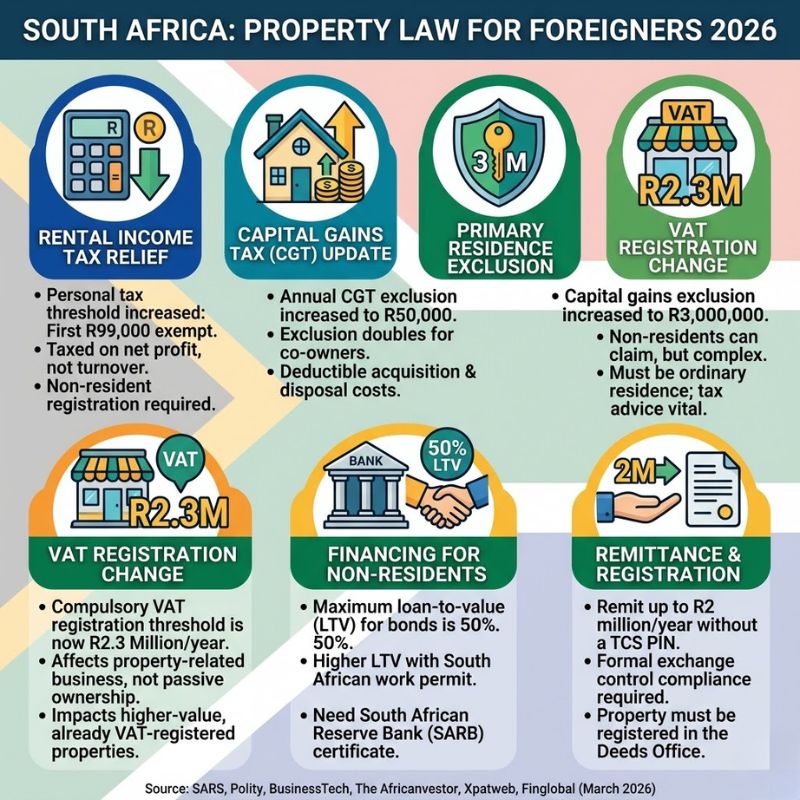
The revised tax framework also affects the tax free threshold applied to rental income earned locally. Botha highlighted that a R30,000 threshold remains in place for rental income in terms of filing requirements. This means that even if a foreign property owner does not generate enough income to incur tax, they may still be required to submit returns to the South African Revenue Service.This compliance requirement ensures that foreign investors remain within the legal tax framework, even in cases where no direct tax payment is due. As a result, administrative responsibilities may increase despite limited taxable income.


Capital Gains Tax Changes And Property Sale Benefits
Another key adjustment involves capital gains tax. The annual CGT exclusion has been increased from R40,000 to R50,000, offering additional relief to investors when disposing of property. Botha explained that this increase improves the tax free portion available on gains.

He further noted that, under certain conditions, a tax-free amount of up to R297,500 can apply if the capital gain represents the only income for that assessment year. Additionally, the primary residence exclusion has been raised to R3 million, although foreign nationals may find it difficult to qualify due to residency definitions.
VAT Threshold Increase And Investor Impact
The budget also introduced a higher VAT registration threshold, moving from R1 million to R2.3 million. This change is beneficial for smaller investors who are unlikely to reach the new threshold, reducing their administrative burden and potential VAT obligations.However, wealthier foreign investors may face disadvantages. In cases where a property is already VAT-registered and later converted into a personal or holiday residence, owners may no longer be able to claim input VAT. This situation can result in financial losses, particularly for high-value property buyers.
Joint Ownership Can Provide Tax Advantages
Botha also emphasised the benefits of joint property ownership for foreign nationals. Unlike some countries that allow joint tax filing, South Africa operates on an individual tax system. This means that each partner must file separately, allowing income to be split evenly between them.This structure can effectively double certain tax benefits. For example, the tax-free rebate threshold of R99,000 can increase to R198,000 when shared between spouses. Similarly, capital gains exclusions can be applied individually, enhancing overall tax efficiency. As a result, joint ownership is often recommended for foreign investors seeking to optimise their tax position.
Key Tax Changes Summary For Foreign Investors
| Category | Update | Impact |
|---|---|---|
| Tax Brackets | Adjusted for inflation | Improves tax thresholds |
| Rental Income | R30,000 filing threshold | Filing required even without tax liability |
| Capital Gains Tax | Exclusion increased to R50,000 | Higher tax-free gains on property sales |
| Primary Residence | Exclusion increased to R3 million | Limited benefit for non-residents |
| VAT Threshold | Raised to R2.3 million | Less compliance for small investors |
| Joint Ownership | Income split between partners | Doubles certain tax benefits |